

SEO Is Dead. Long Live AEO.
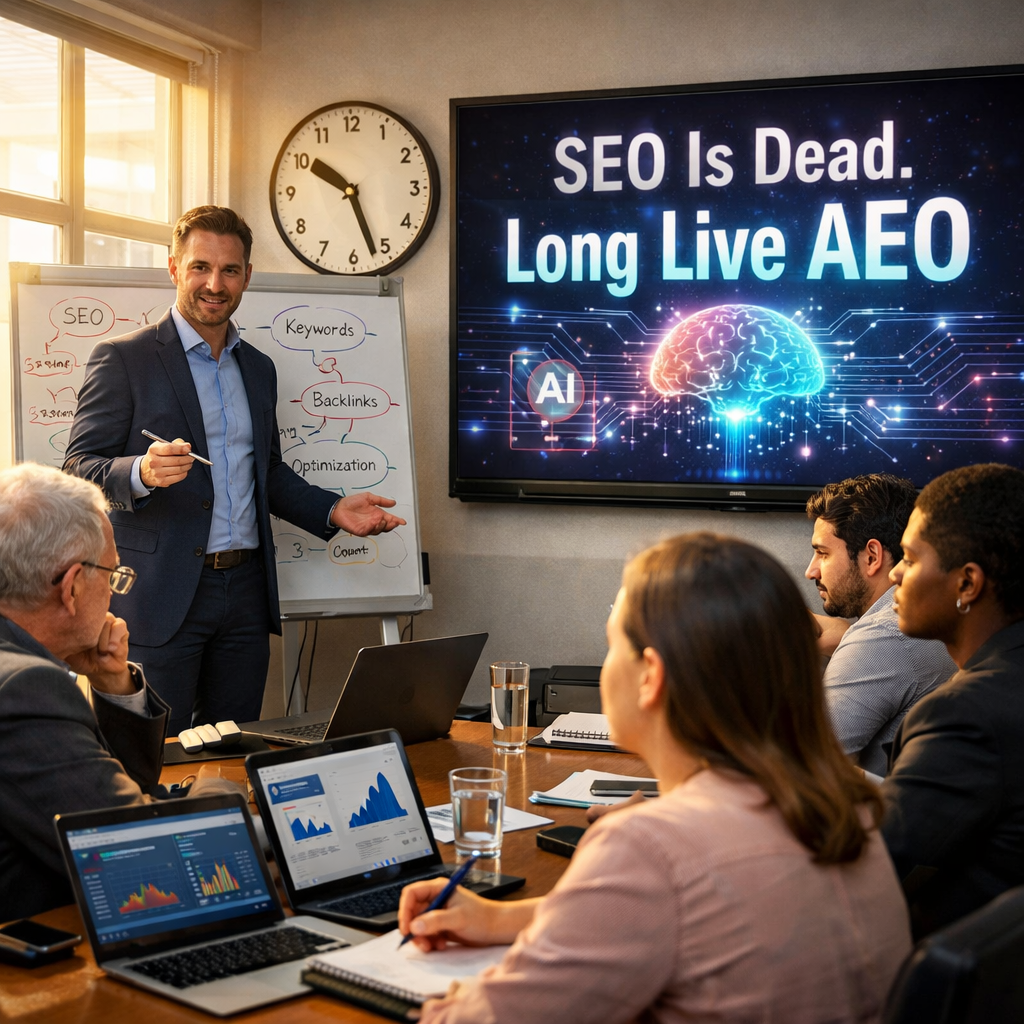
I sat in a meeting recently with a marketing team that had hired an outside SEO consultant. He was sharp. He knew his stuff. He threw around terms like Google Tag Manager, crawl budgets, canonical tags. Impressive in the right room.
But here is the question nobody in that room could answer: was any of it producing revenue?
The consultant's job, as he defined it, was to get clicks. More traffic. Better rankings. And by his metrics, he was doing fine. The problem was that the company's actual revenue team had no idea where their best clients were coming from. They could not connect a single dollar of new business to a single marketing effort. They had hired someone to drive traffic to a store and forgotten to ask whether anyone was buying anything.
I am not picking on that consultant. That playbook worked for a long time. But the game has changed, and most businesses have not caught up yet.
THE SHIFT NOBODY IS TALKING ABOUT LOUDLY ENOUGH
Gartner projects that traditional search engine volume will drop 25% by 2026 as consumers shift to AI-powered answers. Think about what that means. One in four searches that would have gone to Google is now going somewhere else — to ChatGPT, Perplexity, Google's own AI Overviews, or one of a dozen other tools that give you an answer instead of a list of links.
AI Overviews already appear in nearly half of all Google searches. And according to SparkToro research, roughly 60% of searches now end without a single click. People are getting the answer and moving on. If you are not the answer, you are invisible.
This is not a future problem. It is happening right now, and most marketing budgets are still being spent optimizing for a search behavior that is rapidly becoming the minority.
THE DIFFERENCE BETWEEN SEO AND AEO
Search engine optimization is about signals. Keywords, backlinks, page speed, domain authority. Machines reading machines.
Answer engine optimization is about clarity. Can an AI read your content, understand what you do, extract a direct and useful answer, and confidently cite you as the source? That is a completely different question.
SEO asks: how do I rank higher?
AEO asks: how do I become the answer?
The tactics look similar on the surface but the underlying logic is fundamentally different. Ranking is about competing with other websites. Being the answer is about serving the person asking the question better than anyone else does.
WHAT AEO ACTUALLY LOOKS LIKE IN PRACTICE
The basics are not complicated, but most websites are not doing them.
Every piece of content should answer a specific question. Not gesture at a topic. Answer a question. Put the answer in the first paragraph, not buried at the bottom after three sections of background. AI models pull the clearest, most direct answer they can find. If your content buries the lead, you will not get cited.
Use structured headers that mirror how people actually ask things. Not "Our Services" but "What does a HubSpot implementation partner actually do?" Not "About Us" but "How long does a HubSpot migration take?"
Add FAQ schema to your key pages. HubSpot CMS supports this natively and it helps AI models parse and cite your content correctly. This is one of the lowest effort, highest return changes you can make today.
Write with authority and specificity. Generalist content does not get cited. Content that takes a clear position, uses real examples, and answers a question definitively is what surfaces when someone asks an AI for a recommendation.
THE WEBSITE THAT TAKES A YEAR TO BUILD
The same company I mentioned at the start was in the middle of a website revamp. Timeline: twelve months.
By the time their new site goes live, they will have missed an entire year of potential AEO traction. Then they will spend another six months saying they need to wait and see how it performs. That is eighteen months of standing still while the world moves.
I told them I was revamping my own blog and expected to be done in three days. Not because I cut corners, but because the goal is not perfection. The goal is to get something working, see what resonates, and improve it. We are in an iterative world now. A week-long sprint that gets something live and learning will outperform a year-long project every single time.
THE QUESTION WORTH ASKING
If someone opened an AI assistant right now and typed a question that your best client would ask before hiring someone like you, would your name come up?
If the answer is no, that is where to start. Not with a twelve-month project. With one well-written, clearly structured, genuinely useful piece of content that answers one real question better than anyone else on the internet.
Do that ten times and you have a content strategy. Do it consistently and you have a brand.